When we think about protein, many of us picture athletes, bodybuilders or people trying to build muscle in the gym.
But protein isn’t just for sport.
As we get older, it becomes increasingly important for maintaining muscle strength, mobility and independence.
From around our 30s onwards, we naturally begin to lose muscle mass.
This gradual loss of muscle mass, known as sarcopenia, accelerates with age. It's one reason why everyday activities such as climbing stairs, carrying shopping or getting out of a chair can become more difficult over time.
The encouraging news is that research suggests eating enough protein, alongside regular physical activity, may help slow this process and support healthy ageing.
One reason is something scientists call anabolic resistance.
In simple terms, as we age our muscles become less responsive to the protein we eat. This means older adults often need slightly more protein than younger adults to stimulate muscle maintenance and repair.
Several international expert groups and recent scientific reviews suggest that many healthy older adults may benefit from consuming around 1.0–1.2g of protein per kilogram of body weight each day, particularly when combined with regular resistance exercise such as weight training, resistance bands or bodyweight exercises.¹²
It is important to stress that these are expert recommendations based on current evidence. They are not the official UK recommendation, which remains the Reference Nutrient Intake (RNI) of 0.75g of protein per kilogram of body weight each day.

Perhaps not.
Researchers studying the diets of older adults in the UK found that fewer than half consumed the current UK recommended intake of protein, while fewer than 15% achieved the higher intakes suggested by many experts for healthy ageing.
Perhaps most strikingly, only one participant consumed around 25–30g of protein at each of their three daily meals, with breakfast consistently providing the least protein.³
In practical terms, rather than eating very little protein at breakfast and most of it with your evening meal, aim to include a good source of protein at each meal.
The current UK Reference Nutrient Intake (RNI) for adults is 0.75g of protein per kilogram of body weight each day.
However, several international expert groups and recent scientific reviews suggest that many healthy older adults may benefit from around 1.0–1.2g/kg/day to help maintain muscle mass and physical function as they age.¹
| Weight | Current UK RNI (0.75g/kg) | Suggested intake for healthy older adults (1.0–1.2g/kg)* |
|---|---|---|
| 8 stone (51kg) | 38g | 51–61g |
| 9 stone (57kg) | 43g | 57–68g |
| 10 stone (64kg) | 48g | 64–77g |
| 11 stone (70kg) | 53g | 70–84g |
| 12 stone (76kg) | 57g | 76–91g |
| 13 stone (83kg) | 62g | 83–100g |
*The values in the third column reflect protein intakes suggested by several international expert groups and recent scientific reviews for healthy older adults. They are intended to support healthy ageing and muscle maintenance and should not be interpreted as official UK dietary recommendations.
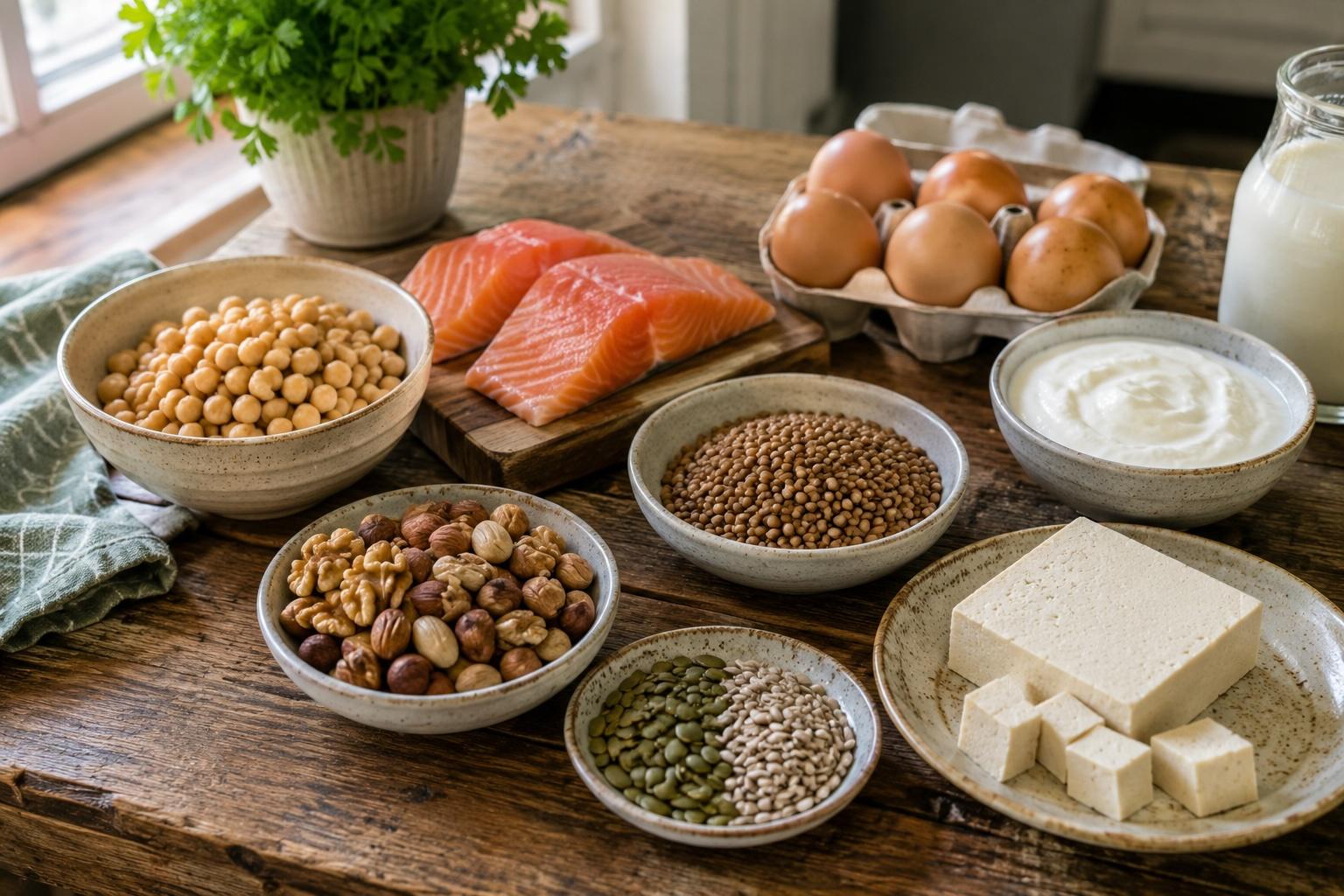
Both animal and plant foods can provide high-quality protein.
Animal foods such as fish, eggs, poultry, milk and yoghurt naturally contain all nine essential amino acids needed by the body and are generally well absorbed.
Plant foods including beans, lentils, chickpeas, tofu, tempeh, nuts and seeds are also excellent protein sources. They also provide fibre and many beneficial vitamins and minerals.
Eating a varied diet containing different plant protein sources throughout the day provides all the essential amino acids most people need.
For most people, a balanced diet containing a mixture of animal and plant proteins is an excellent approach.
Here are some typical examples:
2 eggs – 13g
Greek yoghurt (200g) – 20g
Chicken breast (100g cooked) – 31g
Salmon (100g cooked) – 22g
Cottage cheese (100g) – 11g
Tofu (100g) – 16g
Cooked lentils (100g) – 9g
Cooked chickpeas (100g) – 8g
Semi-skimmed milk (250ml) – 9g
Research suggests it probably helps.
Rather than focusing on one large protein-rich meal, aim to include a source of protein at breakfast, lunch and dinner. Studies suggest this pattern may stimulate muscle protein synthesis more effectively than eating most of your protein with your evening meal.⁴
For example:
Eggs or Greek yoghurt at breakfast.
Chicken, tuna, beans or hummus at lunch.
Fish, lean meat, tofu or lentils at dinner.

For most people, no.
A balanced diet containing dairy foods, eggs, fish, lean meat, beans, lentils or tofu can usually provide all the protein you need. Protein powders may be convenient for people with a poor appetite or those recovering from illness, but they are not essential for healthy ageing.
Those following a vegan or vegetarian diet may need to plan meals a little more carefully to ensure they're getting enough protein from a variety of plant sources throughout the day.
For most healthy adults, eating a little more protein than the recommended minimum from ordinary foods is unlikely to be a concern.
Large scientific reviews have found no consistent evidence that higher-protein diets harm kidney function in people with healthy kidneys.⁵
However, anyone with chronic kidney disease, or who has been advised to follow a low-protein diet, should seek medical advice before significantly increasing their protein intake.
Protein isn’t just for athletes.
As we get older, maintaining muscle becomes increasingly important for staying active, mobile and independent.
Although the current UK recommendation remains 0.75g/kg/day, a growing body of research suggests that many healthy older adults may benefit from modestly higher intakes, particularly when combined with regular strength-based exercise.
Fortunately, increasing your protein intake doesn’t require expensive supplements or complicated diets. Simply including a good source of protein with each meal is a practical step that may help support healthy ageing.

1. Can you build muscle after the age of 60?
Yes. While building muscle becomes more difficult with age, research shows that older adults can still increase muscle strength and muscle mass through regular resistance exercise combined with adequate protein intake.
2. Is it better to eat protein after exercise?
Eating protein within one to two hours after exercise may help support muscle repair and growth. However, for most people, consuming enough protein across the whole day is likely to be more important than precise timing.
3. Do I need protein if I don’t exercise?
Yes. Protein is essential for everyone, not just people who exercise. It helps maintain muscles, bones, skin and other tissues throughout life. As we get older, our muscles become less responsive to protein, so many experts believe healthy older adults may benefit from slightly higher protein intakes even if they are not exercising regularly. However, combining adequate protein with regular strength-based activity appears to provide the greatest benefits.
4. How much protein should I eat at breakfast?
Breakfast is often the meal that contains the least protein, yet research suggests spreading protein evenly throughout the day may be beneficial for maintaining muscle. Aim to include a good source of protein at breakfast, such as eggs, Greek yoghurt, cottage cheese, milk, or a plant-based option like tofu. For most people in the weight ranges shown above, aiming for roughly 20–30g of protein at breakfast is a reasonable practical target, though individual needs vary.
5. Are plant proteins as good as animal proteins?
Both can support good health. Animal proteins naturally contain all the essential amino acids, while a varied plant-based diet provides everything most people need.
This article is for general information only and is not intended to treat or diagnose medical conditions. If in doubt please check with your GP first.
Harris S, DePalma J, Barkoukis H. Protein and Aging: Practicalities and Practice. Nutrients. 2025;17(15):2461. doi:10.3390/nu17152461.
Park Y, et al. Effects of Increased Protein Intake on Muscle Mass and Strength: A Systematic Review and Meta-analysis. Nutrients. 2022;14:1063.
Morris S, et al. Inadequacy of Protein Intake in Older UK Adults. Geriatrics. 2020;5(1):6.
Mamerow MM, Mettler JA, English KL, et al. Dietary Protein Distribution Positively Influences 24-Hour Muscle Protein Synthesis in Healthy Adults. Journal of Nutrition. 2014;144(6):876–880.
Devries MC, Sithamparapillai A, Brimble KS, Banfield L, Morton RW, Phillips SM. Changes in Kidney Function Do Not Differ Between Healthy Adults Consuming Higher- Compared with Lower- or Normal-Protein Diets: A Systematic Review and Meta-analysis. Journal of Nutrition. 2018;148(11):1760–1775.

Mediterranean Diet Slashes Early Death Risk in Women by Nearly 25%, Study Finds

Bananas: Effective in Lowering Blood Pressure New Study Suggests

Shedding Just 5%: The Small Weight Loss with Massive Benefits