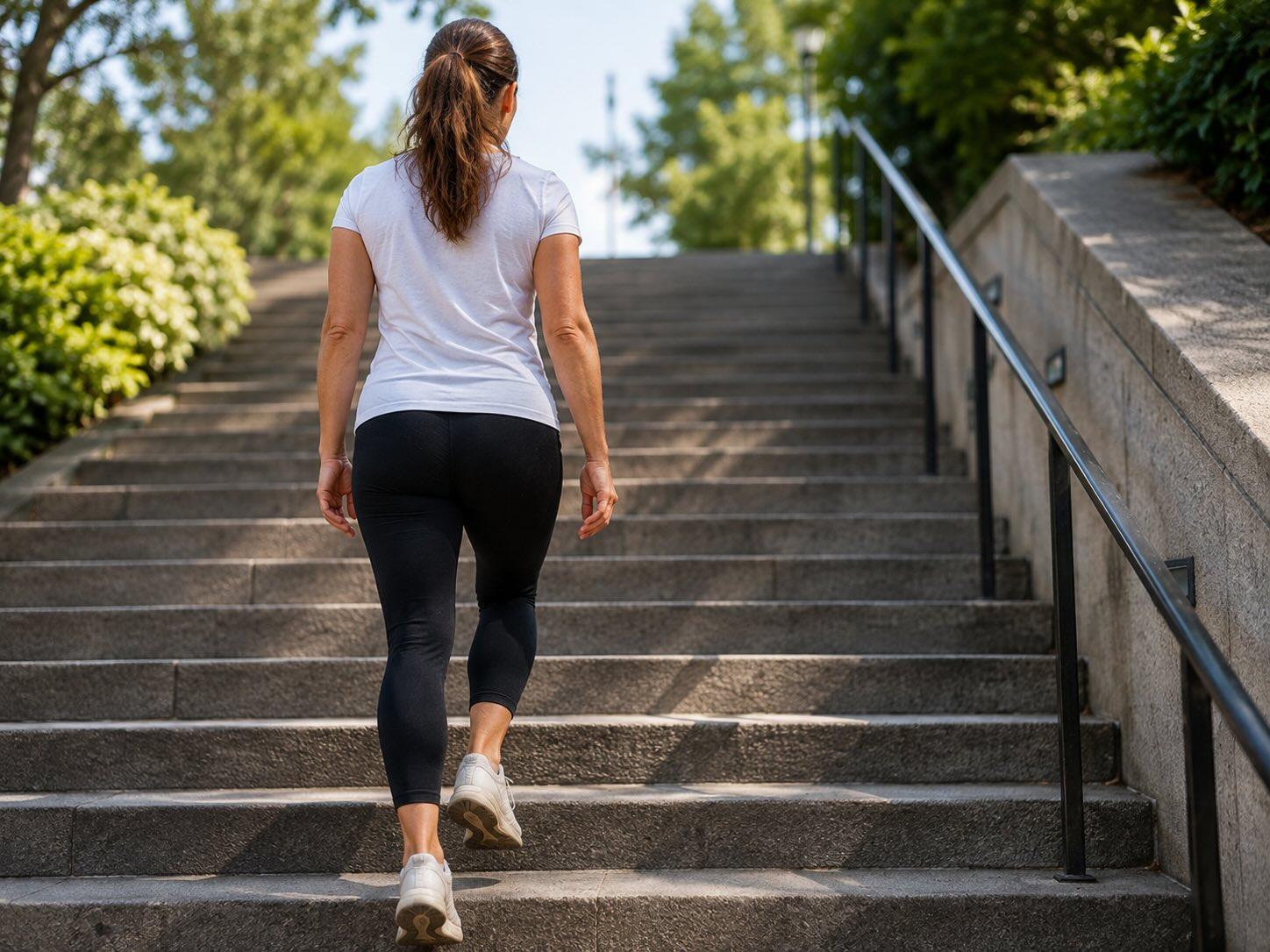
Taking the stairs instead of the lift could be good for your heart — and may even be associated with a longer life.
New research from the University of East Anglia (UEA) and Norfolk and Norwich University Hospital found that people who regularly climbed stairs had a 39% lower risk of dying from cardiovascular disease and a 24% lower risk of dying from any cause, compared with people who did not regularly climb stairs.[1]
They were also less likely to develop cardiovascular conditions including heart attack, stroke and heart failure.
The findings were published in the American Journal of Cardiovascular Drugs in 2026.[1]
Researchers carried out a systematic review and meta-analysis, bringing together the results of nine studies involving more than 480,000 people.[1]
Participants ranged in age from 35 to 84 and included both healthy people and those with a previous history of heart problems.
When the results were combined, stair climbing was associated with:
39% lower risk of dying from cardiovascular disease
24% lower risk of dying from any cause
A lower risk of cardiovascular conditions including heart attack, stroke and heart failure.[1]
There is an important distinction here. The research found an association between stair climbing and lower cardiovascular and overall mortality. It does not prove that stair climbing itself caused the reduction.
However, the results support existing evidence that being physically active is associated with better cardiovascular health and a lower risk of premature death.[2]

Walking upstairs requires considerably more effort than walking on level ground. Your leg muscles have to lift your body weight against gravity, while your heart rate and breathing increase to meet the additional demand.
The NHS classifies walking upstairs as an example of vigorous-intensity activity.[3]
This means the stairs at home, work or the railway station can provide short periods of relatively intense activity without setting aside additional time for exercise.
Previous research has also found that brief periods of stair climbing can improve cardiorespiratory fitness.[4]
The researchers say there isn’t yet enough evidence to give a specific recommendation for the number of stairs people should climb each day.
One of the large studies included in the research found that climbing around six flights of stairs a day was associated with lower cardiovascular risk.[1]
However, this doesn’t mean that six flights should be regarded as a specific daily target.
The studies measured stair climbing in different ways, and further research is needed to establish how the amount and frequency of stair climbing affect cardiovascular health.
Dr Sophie Paddock, from UEA’s Norwich Medical School and a cardiology specialist registrar at Norfolk and Norwich University Hospital, said that some of the studies showed greater benefits as the amount of stair climbing increased, but even relatively small amounts were associated with measurable benefits.[5]

Unlike many forms of exercise, stair climbing is easy for most of us to do and doesn’t require any special equipment.
Physical activity doesn’t only include organised exercise or sport. Walking to the shops, gardening, cycling, carrying shopping and taking the stairs all contribute towards how active we are.
UK guidelines recommend that adults aim for at least 150 minutes of moderate-intensity activity each week or 75 minutes of vigorous-intensity activity, or an equivalent combination of the two.[2][3]
Adults should also aim to do strengthening activities on at least two days a week.[3]
Importantly, the UK Chief Medical Officers’ guidance emphasises that any physical activity is better than none, and that even relatively small increases in activity can provide health benefits.[2]
So you don’t need to suddenly start running or spending hours in the gym.
Walking more often, taking the stairs rather than the lift and breaking up long periods of sitting are all ways of increasing the amount of movement in your day.
Cardiovascular disease remains one of the leading causes of death worldwide.[6]
Being physically active is one of the established ways of reducing cardiovascular risk.
According to the NHS, regular exercise can help reduce the risk of heart disease, stroke and type 2 diabetes.[7]
It can also help with maintaining a healthy weight and has beneficial effects on blood pressure, cholesterol and blood sugar control.
The stair-climbing research is therefore consistent with the wider evidence: activities that regularly increase your heart rate and breathing can contribute towards better cardiovascular health.

For most people, there’s no need to count flights of stairs or set a daily target. When both options are practical, choosing the stairs rather than the lift is one way of increasing the amount of physical activity in your day.
Professor Vassilios Vassiliou, from UEA’s Norwich Medical School, described stair climbing as a practical and often overlooked way of building physical activity into daily life.[5]
Stair climbing may not be appropriate for people with certain mobility problems, joint conditions or health conditions that limit physical activity.
If you have a health condition that affects your ability to exercise safely, check with your GP or healthcare professional about what level of activity is appropriate for you.
There are plenty of other ways to be active if stairs aren’t suitable. Walking, swimming, cycling and gardening can all contribute towards weekly physical activity.
The latest research found that people who regularly climbed stairs had a 39% lower risk of dying from cardiovascular disease and a 24% lower risk of dying from any cause than people who did not regularly climb stairs.[1]
These figures show an association rather than proving that taking the stairs directly causes a longer life.
But they add to the considerable evidence showing that regular physical activity is important for cardiovascular health.
Sometimes it can be as straightforward as taking the stairs rather than the lift.

1. Does climbing stairs really reduce the risk of dying by 39%?
The research found that people who regularly climbed stairs had a 39% lower risk of dying from cardiovascular disease compared with those who did not regularly climb stairs. However, this was an association, so the study does not prove that stair climbing itself caused the lower risk.
2. How many flights of stairs should I climb each day?
There is currently no official recommendation for a specific number of flights. One study included in the research suggested that around six flights a day may provide substantial benefits, but researchers say more research is needed to establish the optimum amount.
3. Does climbing stairs count as exercise?
Yes. The NHS lists walking upstairs as an example of vigorous-intensity activity, as it makes you breathe harder and increases your heart rate.
4. Is climbing stairs better than walking?
Both can contribute towards your weekly physical activity. Stair climbing is generally more intensive than walking on level ground, and the NHS lists walking upstairs as vigorous-intensity activity.[3] The most appropriate activity will depend on your fitness, health and mobility.
5. What if I can’t manage stairs?
Stair climbing isn’t suitable for everyone, particularly people with certain mobility or joint problems. Other activities such as walking, swimming, cycling or gardening can also help you become more active.
This article is for general information only and is not intended to treat or diagnose medical conditions. If in doubt please check with your GP first.
1. Paddock S, et al. Evaluating the Impact of Stair Climbing on Cardiovascular Risk Reduction: A Systematic Review and Meta-analysis. American Journal of Cardiovascular Drugs. 2026.
2. UK Chief Medical Officers. UK Chief Medical Officers’ Physical Activity Guidelines. Department of Health and Social Care, 2019.
3. NHS. Physical activity guidelines for adults aged 19 to 64. NHS.
4. Jenkins EM, Nairn LN, Skelly LE, Little JP, Gibala MJ. Do stair climbing exercise “snacks” improve cardiorespiratory fitness? Applied Physiology, Nutrition, and Metabolism. 2019;44(6):681–684.
5. University of East Anglia. Research commentary accompanying Evaluating the Impact of Stair Climbing on Cardiovascular Risk Reduction, 2026.
6. World Health Organization. Cardiovascular diseases (CVDs). WHO.
7. NHS. Exercise – health benefits. NHS.

Mediterranean Diet Slashes Early Death Risk in Women by Nearly 25%, Study Finds

Bananas: Effective in Lowering Blood Pressure New Study Suggests
Shedding Just 5%: The Small Weight Loss with Massive Benefits