When we think about healthy ageing, the conversation usually centres on cholesterol, blood pressure, blood sugar and weight.
Muscle rarely receives the same attention.
Yet muscle strength may be one of the clearest indicators of how well we age — and how independent we remain.
From midlife onwards, muscle mass and strength begin to decline gradually.
The change is subtle. A heavier bag feels more noticeable. Stairs take slightly more effort. Balance feels less automatic.
Individually, these shifts seem minor.
Over time, they matter.
Age-related muscle loss — known as sarcopenia — begins slowly from our 30s and tends to accelerate after 50.
How common it is depends on how it’s measured. A large review of older adults living independently found estimates ranging from around 10% to 40%, depending on the definition used [1].
In simple terms, it isn’t rare.
It becomes more common with age, inactivity and long-term health conditions.
Research from UK Biobank shows that lower grip strength — a simple measure of overall strength — becomes increasingly common later in life and is linked with poorer health outcomes [2].
That’s why the NHS recommends including muscle-strengthening activity at least twice a week alongside aerobic exercise [3].
This isn’t about building large muscles.
It’s about maintaining capability.
Large long-term studies show that people with lower grip strength tend to have a higher risk of earlier death [2].
Reviews of many studies combined have found similar results: strength predicts health outcomes independently of body weight and other common risk factors [4].
In other words, strength seems to reflect overall resilience.
It isn’t cosmetic.
It’s practical.
Muscle plays a major role in controlling blood sugar. It’s one of the main tissues that helps move glucose out of the bloodstream and into cells.
Studies show that lower muscle mass is linked with a higher risk of developing type 2 diabetes [5–7]. Maintaining muscle helps support steadier blood sugar control — particularly important from midlife onwards.
Falls are common in later life. Around one in three adults over 65 fall each year in the UK, and the risk increases further after 80 [8]. Lower-body strength and balance are key factors.
Strength training doesn’t stop ageing. But it helps you stay steady within it.

Long-term studies, including research from UK Biobank, show that lower grip strength is linked with a higher risk of cognitive decline and dementia [2,9].
Across several large analyses, greater muscle strength is consistently associated with better cognitive outcomes [9,10].
This doesn’t mean strength prevents dementia. But it may reflect broader brain and body resilience.
Walking is excellent for heart health, mood and circulation.
But walking alone doesn’t always provide enough resistance to maintain muscle strength — especially in the upper body.
The NHS recommends:
At least 150 minutes of moderate activity each week
Plus strength-focused activity on two or more days per week [3]
Cardio supports endurance. Strength supports stability. Both matter.
Muscle responds to effort — even later in life.
Studies in people in their 60s, 70s and beyond show improvements in strength, balance and daily function with regular resistance exercise.
You don’t lose the ability to improve. You just need to give your body a reason.

Exercise sends the signal. Protein provides the materials.
The general UK reference intake is about 0.75 grams per kilogram of body weight per day. However, many experts suggest older adults may benefit from slightly higher intakes:
Around 1.0–1.2 g/kg daily for most healthy older adults
Higher amounts for those who are very active or recovering from illness [11,12]
| Body Weight | Approx kg | 1.0 g/kg | 1.2 g/kg | 1.6 g/kg |
|---|---|---|---|---|
| 8 st | 50.8 kg | 51 g | 61 g | 81 g |
| 9 st | 57.2 kg | 57 g | 69 g | 91 g |
| 10 st | 63.5 kg | 64 g | 76 g | 102 g |
| 11 st | 69.9 kg | 70 g | 84 g | 112 g |
| 12 st | 76.2 kg | 76 g | 91 g | 122 g |
Tip: On mobile, swipe the table left/right to see all columns.
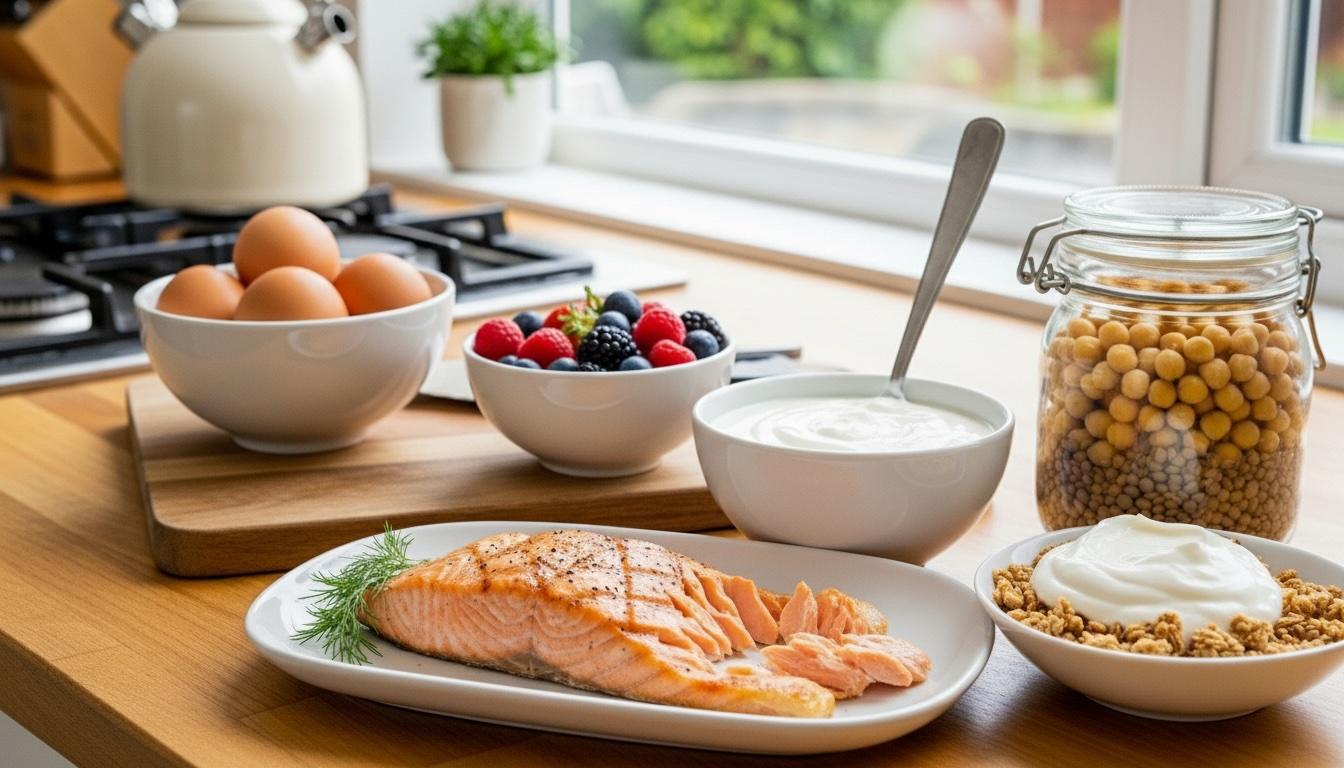
Research suggests aiming for around 20–40 grams of protein per meal, rather than having most of it in one sitting [13,14]. Even distribution helps ageing muscle respond more effectively.
Examples of Lean Protein Sources
Chicken and turkey
Oily and white fish
Eggs
Lean beef
Greek yoghurt
Cottage cheese
Including a source of protein at breakfast, lunch and dinner is generally more effective than having most of it in one meal.
Plant-based diets can support muscle health. However, plant proteins may contain slightly lower amounts of certain key amino acids and may be a little less efficiently absorbed than many animal proteins [15–17].
This doesn’t make them inadequate. It just means quantity and variety matter.
Good plant protein sources include:
Tofu and other soy products
Lentils, chickpeas and beans
Quinoa
Pea and rice protein combinations
Combining foods (such as beans with grains) improves overall protein quality.
Vegetarians and vegans sometimes have lower natural creatine stores, and creatine monohydrate (3–5 g daily) is the most studied supplemental form if someone chooses to use it [19,20]. This is optional.
Vitamin D contributes to normal muscle function. The NHS highlights its role in keeping bones, teeth and muscles healthy [21].
In the UK, supplementation is often considered during autumn and winter.
Muscle isn’t about appearance. It represents reserve.
Reserve strength.
Reserve balance.
Reserve independence.
Large long-term studies suggest muscle strength is closely linked with how well we age.
It doesn’t stop time. But it changes how we move through it. And that makes it worth protecting.

1. Is muscle loss inevitable with age?
Some decline is natural. However, regular strength training and adequate protein intake can significantly slow the process and help preserve independence.
2. Is walking enough to maintain muscle?
Walking supports cardiovascular health, but it provides limited resistance stimulus. Muscle-strengthening activity is also recommended at least twice weekly.
3. How much protein do older adults need?
Many experts suggest around 1.0–1.2 g per kilogram of body weight daily for healthy older adults, with higher intakes often discussed for those who are physically active.
4. Can vegetarians and vegans maintain muscle?
Yes. Plant-based diets can support muscle health, but protein intake may need to be slightly higher, and attention to protein quality and distribution is important.
5. Do I need heavy weights?
No. Bodyweight exercises, resistance bands and light weights can be effective when performed consistently and progressively.
This article is for general information only and is not intended to treat or diagnose medical conditions. If in doubt please check with your GP first.
Mayhew AJ et al. The prevalence of sarcopenia in community-dwelling older adults: systematic review. Age Ageing. 2019;48(1):48–56. DOI: 10.1093/ageing/afy106
Celis-Morales CA et al. Grip strength and health outcomes in UK Biobank. BMJ. 2018;361:k1651. DOI: 10.1136/bmj.k1651
NHS. Physical activity guidelines for adults.
García-Hermoso A et al. Muscular strength as a predictor of mortality. Br J Sports Med. 2018;52:1279–1287. DOI: 10.1136/bjsports-2017-098772
Hong S et al. Relative muscle mass and risk of incident type 2 diabetes. PLOS ONE. 2017;12:e0188650. DOI: 10.1371/journal.pone.0188650
Larsen BA et al. Muscle mass and incident diabetes in older adults. J Clin Endocrinol Metab. 2016;101:1847–1855. DOI: 10.1210/jc.2015-3643
Srikanthan P & Karlamangla AS. Muscle mass and insulin resistance. J Clin Endocrinol Metab. 2011;96:2898–2903. DOI: 10.1210/jc.2011-0435
UK Government. Falls: applying All Our Health.
Kuo P-L et al. Handgrip strength and incident dementia. Alzheimers Dement. 2023. DOI: 10.1002/alz.12793
Kunutsor SK et al. Grip strength and dementia risk: systematic review. Aging Clin Exp Res. 2022. DOI: 10.1007/s40520-022-02155-3
Bauer J et al. Protein intake recommendations in older people. J Am Med Dir Assoc. 2013;14:542–559. DOI: 10.1016/j.jamda.2013.05.021
Deutz NEP et al. Protein intake and exercise in ageing. Clin Nutr. 2014. DOI: 10.1016/j.clnu.2014.04.007
Landi F et al. Protein intake and muscle health. Nutrients. 2016;8:295. DOI: 10.3390/nu8050295
Traylor DA et al. Per-meal protein dosing and muscle synthesis. Adv Nutr. 2018. DOI: 10.1093/advances/nmy009
Hertzler SR et al. Plant protein quality review. Nutrients. 2020;12:3704. DOI: 10.3390/nu12123704
Herreman L et al. Plant vs animal protein quality. Food Sci Nutr. 2020. DOI: 10.1002/fsn3.1809
Ciuris C et al. Protein digestibility vegetarian vs omnivorous diets. Nutrients. 2019;11:3016. DOI: 10.3390/nu11123016
Matthews JJ et al. DIAAS and essential amino acid density. J Nutr. 2025.
Candow DG et al. Creatine and plant-based diets. 2024.
Kreider RB et al. ISSN position stand: creatine supplementation. J Int Soc Sports Nutr. 2017;14:18. DOI: 10.1186/s12970-017-0173-z
NHS. Vitamin D guidance.

Mediterranean Diet Slashes Early Death Risk in Women by Nearly 25%, Study Finds

Bananas: Effective in Lowering Blood Pressure New Study Suggests

Shedding Just 5%: The Small Weight Loss with Massive Benefits