We all know that too much salt isn’t good isn't good for us.
But how much difference does it really make?
And does cutting back still make a meaningful difference in 2026 — especially if your blood pressure is only slightly raised?
Several major studies published this year provide fresh clarity. These are large reviews and national projections based on real-world data.
The message is consistent: reducing sodium intake lowers blood pressure — and even modest reductions across a population can prevent thousands of heart attacks and strokes.
Here is what the latest evidence shows.
Salt contains sodium. When we consume excess sodium, the body retains more fluid. This increases the volume of blood circulating through the blood vessels.
More fluid means greater pressure against artery walls.
Over time, raised blood pressure increases the risk of:
Heart disease
Stroke
Kidney disease
Vascular dementia
The NHS recommends that adults consume no more than 6g of salt per day (around one level teaspoon).
However, average intake in the UK is still estimated to be around 8–9g per day, meaning many adults are consuming roughly a third more than recommended.
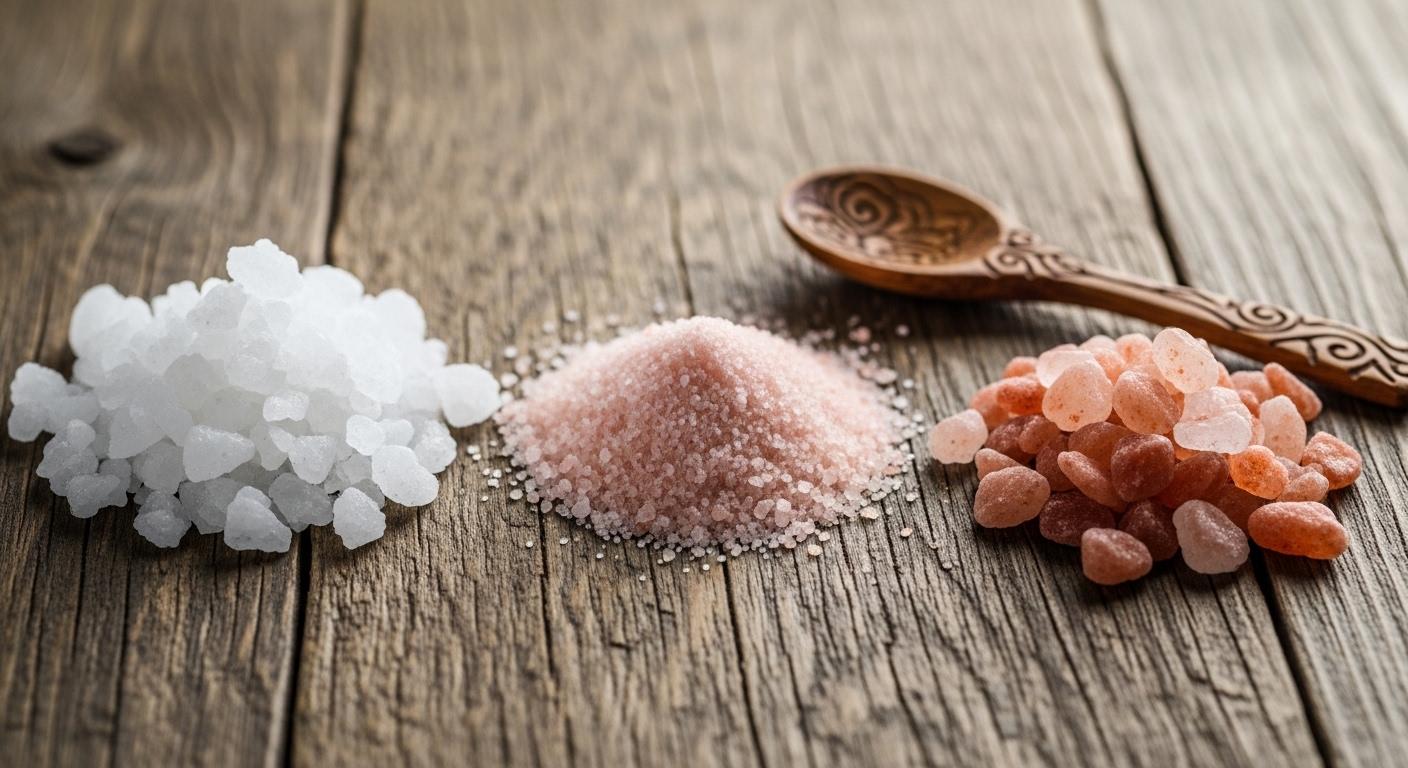
It’s common to hear that certain salts are “healthier”.
Sea salt, Himalayan pink salt and rock salt may contain trace minerals such as magnesium, calcium or iron. However, these minerals are present in extremely small amounts — far too small to have any meaningful physiological effect.
From a blood pressure perspective, what matters is the sodium content.
By weight, sea salt, table salt and Himalayan salt contain almost identical amounts of sodium. The body responds to sodium itself — not the colour, texture, origin or how it is marketed.
The crystals may look different.
The colour may vary.
The packaging may suggest something more natural.
But once dissolved in food and absorbed into the bloodstream, sodium behaves in exactly the same way.
If blood pressure is the concern, the only factor that meaningfully alters risk is how much sodium you consume — not what it is called or where it comes from.
What happens when people actively reduce salt?
One large 2026 review looked at different ways people try to cut down on salt — including using salt substitutes, following lower-salt diets and receiving dietary guidance.
It found that replacing regular salt with reduced-sodium alternatives was one of the most effective approaches. On average, systolic blood pressure fell by nearly 7 mmHg compared with doing nothing.
Structured low-salt diets, particularly when combined with education or self-monitoring, also produced meaningful reductions.
Another major review focused specifically on salt substitutes. Moderate-potassium, lower-sodium salts reduced systolic blood pressure by around 4–5 mmHg on average.
For context, even a 5 mmHg drop is associated with a measurable reduction in stroke and heart disease risk.
That naturally leads to another question:

A separate 2026 study examined how blood pressure changes depending on how much sodium is reduced.
It found that cutting intake by the equivalent of about 2.5 grams of salt per day led to:
A reduction of around 4–5 mmHg in people with chronic kidney disease
A reduction of around 2–3 mmHg in people with high blood pressure
The benefit was greater in those already at higher cardiovascular risk.
In simple terms, reducing sodium consistently lowers blood pressure — and the effect is stronger in people who need it most.
Some of the most important findings this year come from national estimates of what would happen if the average salt intake fell.
Researchers estimated what would happen if the UK fully met its latest salt reduction targets across the food supply.
If average intake fell by just over 1 gram of salt per day, the modelling suggests this could:
Prevent around 103,000 cases of heart disease over 20 years
Prevent around 25,000 strokes
Save the NHS substantial costs
For any one person, a 1 mmHg drop in blood pressure may not feel dramatic.
Across millions of people, however, the impact becomes substantial.
Small shifts, applied widely, create large public health effects.
Most salt substitutes replace some sodium chloride with potassium chloride.
For the general population, moderate-potassium substitutes appear both safe and effective.
However, they are not suitable for everyone.
People with:
Chronic kidney disease
Advanced heart failure
Those taking certain medications such as potassium-sparing diuretics or ACE inhibitors
should consult their GP before using high-potassium salt substitutes.
This is not because substitutes are harmful for most people, but because potassium balance must be managed carefully in some medical conditions.

The findings published in 2026 reinforce a long-standing conclusion:
Reducing sodium lowers blood pressure.
Larger reductions produce larger effects.
People at higher risk benefit most.
Even modest population-wide reductions prevent significant numbers of cardiovascular events.
Salt reduction remains one of the simplest and most consistently supported public health measures available.
The 2026 evidence does not suggest extreme restriction is necessary.
Instead, it supports:
Gradually reducing added salt
Checking labels, especially on bread, soups, sauces and ready meals
Cooking more meals at home
Using herbs, spices, garlic and lemon to add flavour
Considering moderate potassium-based salt substitutes where appropriate
Most salt in the UK diet comes from processed foods rather than the salt shaker.
Reformulation by manufacturers plays an important role. Household habits still matter.

1. How much salt should adults in the UK have?
The NHS recommends no more than 6g of salt per day for adults.
2. Does reducing salt really make a difference?
Yes. Studies show reductions of 2–7 mmHg in systolic blood pressure depending on the approach and the individual’s starting level. Even small reductions lower stroke and heart disease risk at population level.
3. Are salt substitutes more effective than just using less salt?
They can be. Moderate-potassium substitutes appear to reduce blood pressure more effectively than simple reduction alone in some studies. However, they are not suitable for everyone, particularly people with kidney disease.
4. Where does most salt in the UK diet come from?
Primarily processed foods, including bread, ready meals, soups, sauces, processed meats and savoury snacks.
This article is for general information only and is not intended to treat or diagnose medical conditions. If in doubt please check with your GP first.
Prommas P, et al. Nutrients. 2026.
Lai H, et al. BMC Medicine. 2026.
Iwelomene O, et al. Clinical Kidney Journal. 2026.
Bandy L, et al. Hypertension. 2026.
Grave C, et al. Hypertension. 2026.
NHS. Salt: the facts.

Mediterranean Diet Slashes Early Death Risk in Women by Nearly 25%, Study Finds
Bananas: Effective in Lowering Blood Pressure New Study Suggests

Shedding Just 5%: The Small Weight Loss with Massive Benefits